The Curious Case of Bellona
 The wonderful Laura began a discussion at Creatures Caves regarding an interesting Norn named Bellona. As it pertained to Creatures 1 and genetics, I naturally jumped right in to try to solve the mystery behind her! In short, Bellona was experiencing odd sleep patterns where she was unable to wake up on her own. This brought her life force down to about 30% at one point, and Deskman even reported her falling asleep for nearly twenty minutes at one time! Bellona was soon imported into a new C1 world, since I wanted to study her with as few distractions as possible. She certainly was a beautiful Norn right from the moment she appeared in my world! My first order of business was to take a look at her genetic mutations.
Note that for the sake of time, uninvolved mutations have not been included. Bellona has a couple of other interesting mutated genes, though! She is available for download at Creatures Caves for those interested.
Lobes
Brain lobes include important information about how the different parts of the brain work, from how concepts are learned to how a Norn goes through the decision process. These genes can greatly affect the learning process.
122 Emb B Mut Lobe #= 8 Dendrite Type 0: Input Lobe=0, Min#=3, Max#=3, Spread=3, Fanout=2
The only difference in this gene is the minimum number of dendrites, which is normally set at just one. Get ready for a scientific explanation that will hopefully make some sense! Dendrites are the connections between different lobes in the brain: In the case of this gene, the dendrites connect from the perception lobe to the concept lobe. The perception lobe is involved in the objects in the world that creatures can perceive and look at. The concept lobe is an important learning lobe, where a good deal of information is fed in order to learn concepts. These dendrite connections migrate, or form new connections, only when all of the associated dendrites are loose. My hypothesis is that Bellona has a decreased capacity for learning new concepts based on what she perceives, because every concept must use exactly three dendrite connections.
Receptors
Chemical receptors define parameters for a certain chemical. When these parameters are met, an element in the Creature is affected. These genes can increase drives, define life stages, control fertility, and more.
129 Emb B MutDupCut Creature, tissue 8, locus 13, chem=Reinforcement, thresh=0, nom=0, gain=255, features=Analogue
This gene is quite a mess when compared with the original gene 129! In the standard Norn genome, the location of this receptor is in Brain, Concept, Chemical 0, which simply corresponds to the correct brain chemical that ties in with reinforcement. In the case of Bellona, it appears that the receptor for reinforcement is located elsewhere. This location translates to a drive level for an unallocated drive. Madness! I gathered that her brain would not be able to process reinforcement in the typical fashion. An unallocated drive would make it impossible to see if reinforcement would end up raising a drive, yet this was a clue that reinforcement could be a problem.
Reactions
Chemical reactions define rules for individual chemicals and chemical combinations. These genes can also state the rules for how chemicals are used up, and each reaction has a defined half-life to determine how often it occurs.
64 Emb B MutDupCut 1*Sleepiness++ => 1*Sleepiness + 1*Reinforcement; half-life = 8
In the standard Norn genome, this reaction produces sleepiness and punishment. This makes sense: An increase in sleepiness should slightly punish a Norn, while a decrease in sleepiness should slightly reward a Norn. Instead, Bellona produces reinforcement from a sleepiness increase. Reinforcement is a bit of a confusing chemical in itself: It is mostly a chemical which reinforces learning, either through reward or punishment. It appeared that Bellona was reinforced when she became more sleepy. However, due to her mutated reinforcement receptor, it could also be the case that a sleepiness increase would do virtually nothing for her.
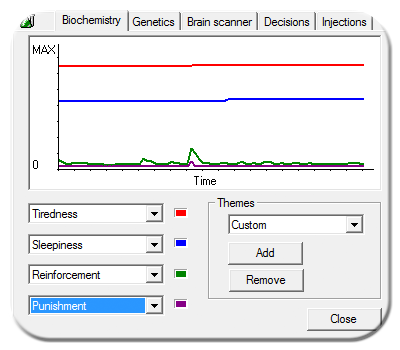 Bellona seemed to experience a fairly typical gain in both tiredness and sleepiness, although the pattern of reinforcement was somewhat different. I tested this same graph with another Norn, and noticed that reinforcement appeared to be more spiky and less like a constant chemical. In Bellona, she occasionally experienced rapid spikes in reinforcement after eating, but this did not occur every time. She also focused on certain objects for long periods of time, and was very quiet for a Norn. She barely spoke at all for about ten minutes as I waited for her to fall asleep! It was a long waiting game, and I wondered when she would ever close her eyes and enter a dream world. Many creatures would have fallen asleep already with the same amount of sleepiness, but not Bellona.
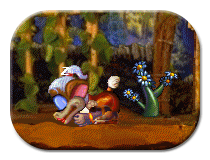 My wish finally came true! Bellona ended up eating every lemon in sight before settling down. I suppose that is a long lost Norn secret to instantaneous sleep! Although she had a slow start, she was quite an excellent eater! The only peculiar thing I noticed was her fascination with the carrot seedlings: After eating one carrot, the seedling became her focal point. She constantly attempted to eat it, and only stopped when I intervened to distract her. Again, I believe that this is a side effect of her lobe mutation, and perhaps even her reinforcement receptor mutation.
 I got ready for a long rest from Bellona, and started the timer. I was very surprised when I noticed how her tiredness and sleepiness fell at a normal rate, and she opened those pretty eyes after two or three minutes. Note the spikes in reinforcement when she experienced decreases in tiredness and sleepiness. There was no doubt in my mind that her body was producing this chemical, but it was not being interpreted by her brain in any form. One important hint about sleeping Norns in Creatures 1, which Tarlia brought up during the discussion of Bellona, is that creatures who move around while sleeping receive no benefits: They either stay just as sleepy, or experience an increase in sleepiness. Perhaps Bellona had been observed in this state at some point. The best thing to do for these Norns is to wake them up.
 Bellona was wide awake again, and I wondered what she would end up doing. Even with many things to grab her attention and interest, she simply focused on herself and never looked away. I saved my own intervention for a little later on, since I was very curious about what this activity would do for her biochemistry. Even a full trellis of lemons probably would not have brought her out of this staring contest. Again, though, this was associated with her perception lobe, and Bellona needed exactly three dendrite connections between neurons in the perception and concept lobes.
 As she focused on herself, Bellona experienced a rapid increase in sleepiness. In its wake, she received an almost constant supply of reinforcement. In a standard Norn, this reinforcement would have been replaced with punishment, so that the Norn would learn that sitting still and doing nothing long enough to raise his or her sleepiness was a punishable offense. After a short period of time, Bellona fell fast asleep again. Since she had trouble related to focusing on stimulating objects, I could understand how this cycle might continue indefinitely. Notice how soon she drifted off to sleep, compared with the level of sleepiness in her system when she dozed off previously. Surprisingly, this pattern is actually normal: I witnessed another Norn who focused on herself and experienced a similar increase in sleepiness.
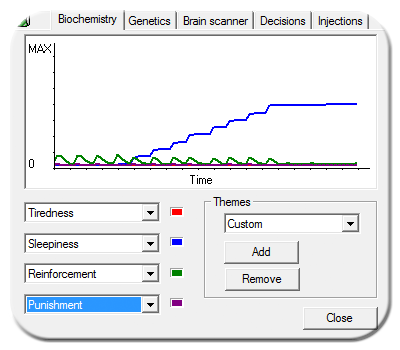 As predicted, as soon as Bellona woke up, she returned to the same self-staring contest! Although this increase in sleepiness is not unusual, the issue with Bellona is the fact that she can not break the cycle on her own. The leveling off of her sleepiness was initiated by a visit from the hand, which seemed to set her back on track. Not only did she enjoy the company, but she decided to have a lovely meal of lemons and carrots! It seemed to me that Bellona suffered more from a focus problem, rather than a sleeping problem. When she began to eat, it was almost like she could not stop eating. The same was true for sleeping, although the issue was a little more pronounced, courtesy of her sleepiness increase mutation. It might also have been a form of hyper-focus, where she could only focus on one concept at a time on her own. A little help did her a lot of good, though.
 Bellona was a wonderful Norn to study! Even after going through an in-depth genetic and biochemistry analysis, I still feel as though I haven’t quite uncovered the mystery surrounding her behavior. I encourage members of the community to download her at some point and embark on similar studies. Special thanks go to Laura for sharing Bellona, and for starting up the discussion! Perhaps this will pave the way for more case studies in the future. Feel free to share any comments, and perhaps suggest additional C1 Norns who could be studied! Good luck to Bellona!


Bellona became obsessed with the Teeny Tiny Immortal Carrot Seedling? Sounds like pretty normal norn behaviour to me. ;)
Thanks for posting up your research on Bellona! :D
Wow, that was one of the more interesting genetics posts we’ve had so far!
I’m itching to get on to my 2nd generation of Norns now, as I’m sure some of my Gen1’s had lobe mutations I didn’t understand before that I might now wrap my head around if they crop up in the Gen2’s.
Wow, that’s interesting! Thank you for such an informative post. When I saw the mention of bellona at the forums it left me wondering, now you’ve answered my questions for me!
I’m glad Bellona could contribute to such an interesting post. :)
Thanks Jessica, for all your research and for sharing your findings; I certainly wouldn’t have been able to understand what was going on inside Bellona all by myself!
Thanks for the excellent feedback! I had a wonderful time studying Bellona, and I’m glad that my findings were quite interesting for everyone! Case studies will certainly become a new feature of Discover Albia!
Malkin: Ha ha! The obsession with the tiny carrot seedlings does seem to be a typical Norn trait. I’ve had a couple of Norns lose interest but hang onto the seedling long enough for it to start growing in their hands! Definitely something I hope to get some pictures of eventually.
ArchDragon: Thanks! Although my explanation might be a little convoluted and possibly not 100% correct, this research has given me a lot more insight into genetics. I was expecting a simple sleeping mutation, but a whole lot more was uncovered! I can’t wait to meet your second generation Norns and find out about their mutations! Good luck!
Kittie: Thank you for taking the time to read through my ramblings! Bellona immediately caught my attention, and I couldn’t pass up the opportunity to take a look at her in detail. I look forward to the next case study and research!
Laura: Most of the thanks goes to you for putting Bellona out there and posting a challenging discussion! She is a very interesting Norn, and I was very surprised to learn that her odd sleeping behavior was a result of multiple genes. Aside from the research, Bellona was a pleasure to spend some time with! Just another example of how mutations can slow down a Norn, but most find ways to adapt. That, or we get involved with a little extra care! Thank you again!
Malkin & DA: I’ve found the same thing with my Norns and the tiny carrots. From what I’ve seen the seedlings immediately start growing in the creatures hand once the full carrot has been eaten. The seedling is still classified as ‘food’ so the creature continues trying to eat it. Naturally it doesn’t have an eat script, so it can’t be gobbled up. I try and snatch the seedling off the creaturse ASAP, as I think it can teach them bad habits.
I wonder if it would be possible to update the C1 carrots so that Norns only recognize full grown carrots as edible… Either that, or make the seedlings invisible? Probably just a nice thought, since I would have figured that it would have been addressed already. I find that feeding carrots outside of the garden seems to be helpful: After the seedling is dropped, it magically makes its way to the garden again! Such a funny little element of the game. Although it’s always been frustrating, I find it to be just another quirky aspect that makes Creatures 1 so interesting!
I wonder if Bellona is a mildly-affected Child of the Mind?
From Y. B. Normal’s Dictionary of Genetic Norn Mutations:
The Child of the Mind Gene
The affected Norn can’t see anything beyond its own body, and has unusual behavior, sitting by itself, staring at things. Only lucky breeders can see a child of the mind survive.
http://www.angelfire.com/in/creaturesmatch/dictionary.html
That sounds about right, Malkin! I had heard of some of the common Norn mutations, but I wish there was a source out there which described the actual genetic and/or biochemical differences. It’s pretty easy to guess, yet I always love actual references! A Child of the Mind appears to have something wrong with their perception lobe, or connections with it. My second generation Norn, Arnes, seems to be a prime example! Although he doesn’t often focus on himself, he rarely moves, aside from turning around. Great point!