A Case Study of Dee the Norn: Part I
 Back in September, Malkin suggested a very interesting Norn of hers as a possible case study. Dee is a C1 Norn descended from the Yin Yang Norns. These were a genetically engineered breed created by Muppet Boy and based on some of the existing genes from breeds such as the Purple Mountain, Forest, Ron, and Wood Norns. Dee can be downloaded from The Creatures Repository, for anyone who would like a first-hand look at her. According to Malkin and my research, Dee may very well be the only available Norn who is related to the Yin Yang Norns! Get ready for a long list of genetic mutations, although the descriptions should be fairly straightforward. This little lady has a lot going on beneath the surface!
Note that the gene numbers will probably not correspond with the standard Norn genome, since Dee has a lot of additional genes. She actually has a total of 413 genes, whereas the standard Norn usually has about 320 genes. For this reason, this case study has been split into multiple parts to make it more manageable for everyone!
Lobes
Brain lobes include important information about how the different parts of the brain work, from how concepts are learned to how a Norn goes through the decision process. These genes can greatly affect the learning process.
117 Emb B Lobe#= 3 at X=53 Y=15 is 1 neuron wide and 16 neurons high. Perflags=2
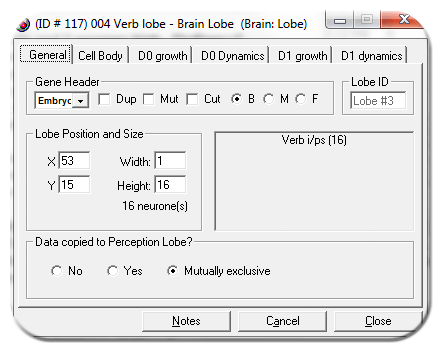 The main difference here is that the verb lobe is located at different coordinates in the brain. In examining the coordinates of the other lobes, we can see that the decision lobe is located under these new coordinates. Effectively, the verb and decision lobes overlap one another. I am not entirely positive how lobe locations affect the brain, but the description at Geatville seems to imply that this will aid in the Norn’s obedience. My assumption is that a spoken verb (i.e. push) will be copied to the decision lobe so that Dee will have to obey. Even though the width and height of the neurons is different, the original genome defines the width as 2 and the height as 8. Both of these calculations arrive at 16 neurons. This mutation is identical to the setup in the decision lobe.
121 Emb B MutDup Lobe #= 7 State Rule: state PLUS type0 PLUS type1 end end end WTA= 1, Loss= 1
This mutation is only listed as a mutation from the standard Norn genome: It is almost identical to the Forest Norn gene. This allows the the attention lobe to take into account dendrites between both the stimulus lobe (type 0) and the noun lobe (type 1). The original Norn genome only linked to the dendrites between the stimulus lobe. For a nice description of this, have a look at Creatures Great and Small! The loss variable is usually set to 0 in the standard genome: Dee’s mutation should not affect her because there is no corresponding loss state rule. I omitted this to save on space, but it includes the end codes in every slot. Suffice to say this gene is unaltered.
118 Emb B Lobe #= 4 at X=44 Y=30 is 5 neurons wide and 8 neurons high. Perflags=0
This mutation is generally identical to that in gene 117. In this case, for Dee’s noun lobe, the new coordinates match up perfectly with the attention lobe. The same is true with the setup of her neurons: In the standard Norn genome, the width is 20 and the height is 2. She has not gained, nor lost, any neurons: This ensures that the noun and attention lobes overlap. Whenever Dee hears a word (i.e. food) her attention is instantly snapped to that object. When we combine the mutations in genes 117 and 118, Dee should obey the hand’s every command.
Receptors
Chemical receptors define parameters for a certain chemical. When these parameters are met, an element in the Creature is affected. These genes can increase drives, define life stages, control fertility, and more.
New 321 Emb B Creature, Circulatory, floating chem 2, chem=Glycogen, thresh=0, nom=0, gain=255, features=Analogue
For the best explanation of this receptor and its corresponding emitter, which will be discussed shortly, have a look at Creatures Great and Small. In essence, this new receptor means that the level of glycogen is stored in Dee’s system in such a way that it can be recognized by its corresponding emitter. A linked receptor-emitter pair is like a team: By themselves, each gene has no purpose. It is when they come together that something happens. Keep this in mind when we reach its corresponding emitter: Gene 322.
Emitters
Chemical emitters define specific conditions within a Creature in order to affect chemicals. Some examples include experiencing stress from excessive drives, becoming cold due to environmental conditions, and more.
309 Old M MutDupCut Creature, tissue 6, locus 0, chem=Testosterone, thresh=0, samp=49, gain=6, features=Digital
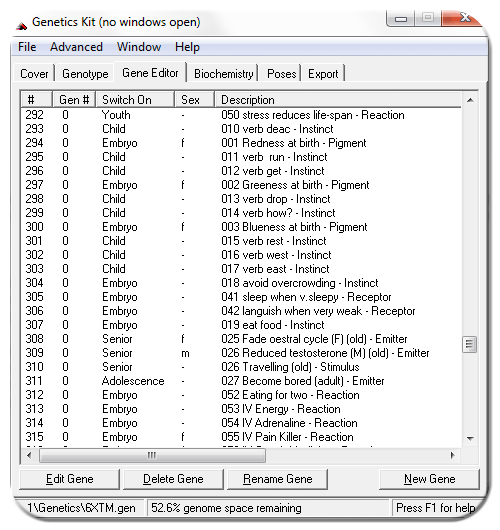
This gene is used to control fertility and testosterone in older male Norns. Just as a female becomes less fertile in old age, the same is true for males. Since this is a gender-based gene, it will not affect Dee. However, it could be passed along to any of her sons, which could affect them in old age. To be honest, I am still perplexed by this gene. In the Genetics Kit, the tissue corresponds with Drive Levels, and the locus matches up with pain. It should be Sensorimotor, Permanently Active. Rather than sense the level of testosterone in an elder male’s system, it appears that this mutation will release testosterone when a male is in pain. Compare this with the emitter that defines how stress from excess pain is handled: It has the identical conditions (Creature, Sensorimotor, Permanently Active) and states that when pain reaches a certain threshold, adrenaline is produced. This could actually be beneficial to older male Norns, in that they might stay fertile a bit longer. In the case of Dee, she will have no effects from this… Unless she spontaneously turns into a male!
New 322 Emb B Creature, Circulatory, floating chem 2, chem=Hunger, thresh=0, samp=5, gain=1, features=Inverted Analogue
Here is the corresponding emitter gene that I mentioned a short time ago when looking at gene 321. This new gene indicates that hunger will be emitted when the glycogen level in Dee’s system is low. Imagine if she was well fed, but decided to eat a Deathcap Mushroom. Her hunger would already have been satisfied by a previous meal, yet her glycogen level would begin to plummet. A standard Norn would not even notice this process, and could die feeling full. Dee’s body would recognize the falling level of glycogen, and would emit hunger to encourage her to seek out food. Quite a useful system in allowing Dee to care for herself!
New 323 Emb B MutDupCut Creature, Sensorimotor, Light level, chem=Glucose, thresh=0, samp=114, gain=1, features=Analogue
I previously mentioned that receptors and emitters work in tandem with one another, like a team. There are certain emitters that no do not require a corresponding receptor, since they focus on outside elements. This new emitter examines the light level, which is not stored in a Norn’s body, but comes from the outside environment. Other examples include “I’m Asleep” or “Crowdedness.” This interesting new gene means that Dee actually produces glucose in her system when the light level is high enough! This comes from the Yin Yang Norns, and this gene in particular is what Muppet Boy titled the photosynthesis gene. Dee could live in a very light area her entire life and never have to eat! Not the ideal scenario, of course, but this is another way that she might gain nutrition in an interesting way.
Initial Concentrations
Initial concentrations define the starting values of different chemicals at birth. The most important of these genes are for glucose and glycogen, allowing babies to survive without needing to eat immediately after hatching.
New 366 Emb B MutDupCut Initial Concentration of Antibody5 is 130
New 366 Emb B MutDupCut Initial Concentration of Antibody6 is 147
New 366 Emb B MutDupCut Initial Concentration of Antibody7 is 140

These three new genes are very simple. A baby Norn with the standard genome receives an initial concentration of antibodies 0, 1, 2, 3, and 4. This creates an initial immunity, although as many might be aware, the standard Norn does not have anything resembling a real immune system. Dee has quite a few mutations and modifications that simulate a much more realistic immune system. These will be discussed later on. Suffice to say that these new genes simply added the missing antibodies to her system at birth, in standard concentrations.
Stimuli
Stimuli genes define the chemicals that a Creature expects to receive in response to an action. These actions can range from interactions with the hand to involuntary actions like coughing or sneezing.
91 Emb B Mut ‘Pointer pats me’ causes sig=32 GS neu=0(I’ve been patted) int=255, , , Sensed Even When Asleep =>64*NFP- + 16*Pain- + 16*Loneliness- + 30*Reward
The standard Norn genome states that when a Norn is patted or tickled by the hand, he or she will experience some very pleasant effects. The normal value of reward is 16, but this different gene nearly doubles the value. In effect, Dee can be rewarded in a much easier way. This also means that she might respond better to being rewarded from tickles, rather than words.
93 Emb B Mut ‘Pointer slaps me’ causes sig=32 GS neu=1(I’ve been slapped) int=255, , , Sensed Even When Asleep => 75*Pain++ + 32*NONE + 50*Anger++ + 16*078
This gene is the converse of the previous, with a few differences. This is the stimulus for when a Norn is slapped by the hand. In the standard Norn genome, this creates 75 pain increase, 32 fear increase, 16 anger increase, and 16 sleepiness decrease. Dee does not receive any fear increase, nor sleepiness decrease. Note that chemical 078 is not defined, so it can be considered another instance of NONE. The anger she receives from a slap is also very high, with its concentration more than three times the standard amount! Effectively, a slap from the hand results in a lot of pain and anger, which can certainly help in deterring bad behavior. Just be careful: Dee is not afraid of the hand!
94 Emb B Mut ‘Creature slaps me’ causes sig=128 GS neu=1(I’ve been slapped) int=255, , , Sensed Even When Asleep => 80*Pain++ + 32*Fear++ + 16*Starch + 16*NONE
This is an interesting mutation! The gene in question is fairly similar to the other stimuli genes we have covered: This one controls the reaction of Dee when she is slapped by another creature. The standard Norn genome defines the chemicals as 80 pain increase, 32 fear increase, 16 anger increase, and 16 sleepiness decrease. In this mutation, the sleepiness decrease has been removed: Slaps from other creatures do not make Dee feel any less sleepy. The most startling change is that rather than creating anger, she actually creates some starch! Creatures can almost “feed” Dee simply by slapping her, which they usually have a knack for! I find this to be a very unrealistic gene, though. The photosynthesis gene discussed earlier made some sense, since it created glucose from light. This one, however, seems a little out there. Still, it’s quite an interesting gene modification!
242 Ado F Mut ‘Invol 1=’lay egg” causes sig=0 GS neu=255 int=0, , , => 190*Pain + 160*Tiredness + 224*CoughMedicine + 32*Hexokinase
At first glance, the changes in this gene may make no sense. Why in the world would laying an egg create cough medicine in a Norn?! The answer lies in the chemical reactions, which will be covered later on. The Yin Yang Norns actually do not react to the injection chemicals in the same way. I will cover this at length, but suffice to say that cough medicine is actually known as sex booster. When injected, it increases estrogen and sex drive, while lowering progesterone. In Dee’s case, her body naturally produces it after she lays an egg. With such an enormous dose, this should mean that it will take her a short period of time to recover from a pregnancy.
Time to take a break! The remainder of Dee’s modified genome will be explored in one or two parts. Thanks again to Malkin for suggesting her! In later parts, I will also observe and report on how these genetic modifications affect Dee in Albia. It’s one thing to explain them here, and quite another to see them at work.




Wow! Thanks for taking such a detailed look at Dee. :) She’s a special little flower – the last of her tribe. It’s good to see her in someone else’s world. :)
The ‘I’ve been hit gives me starch’ gene is probably from the Vampire Norns:
http://creatureswiki.net/wiki/Vampire_Norn
I think it was one of those spontaneous mutations in Creatures that makes no real sense, but it was picked up on as being ‘good’ and eventually engineered into the Yin-Yang Norns. :)
No problem, Malkin! Thanks for the excellent case study suggestion. I imagine it will probably conclude in two more parts… There are a mountain of chemical reactions, but most are very easy to understand. Surprisingly, most of her genes made a good bit of sense to me! This is what I get for pouring my heart into genetics research… I would be worried if I suddenly forgot what starch or glycogen was!
Sounds like a good explanation of the starch gene: It’s funny how some mutations make no sense, but suddenly seem amazing. Thanks for the link, too!
This is awesome!!!