A Celebrated Break from Genetic Mutations
 I never fell in love with the Forest Norn as I did with the standard three Creatures 1 breeds, but Albia was in need of some more diversity. I welcomed little Bera into the world! Her name, pronounced [BEHR-ah], originated from Norse and means bear. She reminded me of a colorful teddy bear as soon as she hatched! Her uniqueness was not only in her appearance, but also in her improved instincts. Among other things, Forest Norns receive an extra reward for approaching food and herbs. This can make them better eaters, and I hoped that Bera would benefit from these better genes. In time, perhaps she would pass them on! I had no problem with getting some positive genes mixed into the population. In fact, I kind of hoped Bera would have a little horde of eggs by the time her life was finished.
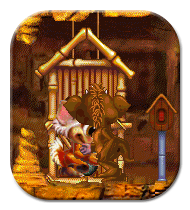 Eydis made her way around Albia and finally settled on a spot to lay her egg. I thought the underground area of the temple seemed a trifle too dark and gloomy, but she seemed to think it was ideal! It was touching that she found Arik to witness the event: He seemed much more shocked and confused than anything else, but at least he was there with Eydis! To cut back on inter-generational breeding, all second generation eggs will remain dormant until all of the first generation Norns have hatched and become adults. This means that the attention lobe mutation that this baby has will not be seen in action for a bit. He or she will hatch in the near future, though! I’m as anxious to see the actual effects as everyone else must be. Hold tight for just a little longer!
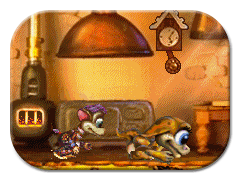 Bera remained very solitary during her early moments: She was content with watching the bees buzz around her, especially since she didn’t get stung quite as much as Eydis! Her first encounter was with Signe, and the two seemed inseparable for quite some time. More importantly, Signe had reached adulthood and it was time to find out, once and for all, whether she would be infertile due to her genetic mutation. Remember that Gene 153 is a chemical receptor which states that a female Norn will become fertile if the estrogen level is high.
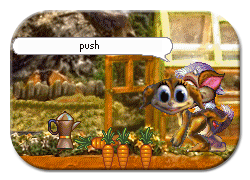 The early signs were promising! Truett and Signe kiss popped in the garden, and I desperately hoped that she would somehow become pregnant. The one positive thus far was the fact that Signe was not affected by the other mutation, which would have caused her to feel pain, fear, and anger when something approached her. She was actually one of the happiest Norns in Albia! Rarely did she display a frown, and I was very impressed with her fascination with carrots. Could she become a mother, against all odds?
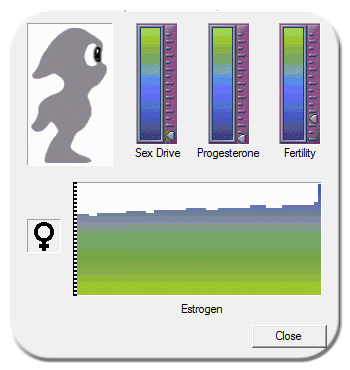 Alas, it could not be so. My hopes were high when Signe had just become an adult, because her estrogen level appeared to be normal. Unfortunately, it kept on rising, and currently remains at the highest level. The graph in the Breeder’s Kit more closely resembles the path of testosterone in males. In short, female Norns can become pregnant only when their estrogen levels are falling. There is a predictable cycle, which I hope to eventually graph. Sadly, I had to accept the fact that Signe would never be able to have her own baby Norns. In more scientific terms, Signe has the correct chemical emitters and chemical reactions that would make her fertile. The problem resides in the chemical receptor: Her body simply does not recognize the level of estrogen in her system. I suspect that this chemical receptor controls the estrus cycle: Indeed, in the Genetics Kit, it is given the description of 020 Oestral cycle (F) – Receptor. Signe will probably be a second mother, and friend, to many youngsters.
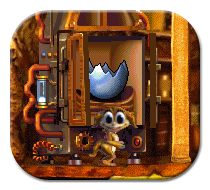 It was important for the Banana Norn to be included in the gene pool. In no way did I want to replace Signe: Every Norn is unique, both genetically and in personality. Little Dagny, pronounced [DAG-neh], was born without any noticeable genetic mutations. Her Norse name means new day, and it certainly was a nice break to uncover a standard genome! Her one mutation exists in the half-life of decASH1: Rather than 0, it is 1. This scale goes up to 248, and the Genetics Kit only allows changes in multiples of eight. In essence, it was a negligible change. I was ecstatic! Perhaps Signe would come to view Dagny as her own: The resemblance is uncanny!


Oh, getting those Forest Norn genes would certainly be helpful.
Poor Signe. Well at least she is a happy norn, and living a good life and can make many friends.
Anonymous said…I found Tabby, the one forest Norn I have in my world to have been the best at taking care of herself. She also sleeps extremely well due to some additional mutaitons, so hopefully you’ll find the same thing with Bera.
Speaking of infertile Norns, I had an interesting one with Lillai recetly, a Pow-wow Norn. She had reached adulthood but hadn’t started producing any estrogen and I was worried she’d turn out infertile despite not finding any mutations that would do this. Then at some stage she kisspopped and almost immediately started prudcing estrogen. Not sure if it was a timing coincidence or if somehow the kisspop had set off her reproductive cycle. I’ll make sure to keep my eyes on her kids.
Great to know that the Forest Norn fares pretty well! I rather like everything about their appearance except for their faces: Still, Bera adds a little extra to the world, and will hopefully pass along those genes! She seemed dumbfounded by food for a short period of time, but it might have been because she simply wasn’t hungry: I have a tendency to always assume Norns need extra food!
Silvak: It’s a shame about Signe being infertile, but I hope she will be able to make her mark on Albia in different ways. It will be interesting to see how she reacts to Dagny!
ArchDragon: That sounds like a very interesting experience with Lillai. I’ve never encountered anything that might explain the first production of estrogen coinciding with kiss popping. All the same, it might not have been a coincidence. It might be worthwhile to keep an eye on her and see if her estrogen production fluctuates depending on kiss popping: My suspicion is that it was just lucky timing, but you never know! I’ve been surprised by genetics and chemical reactions many times already. Good luck to Lillai and her children!
Forest Norns are just adorable enough for me. Also, I never noticed, but does anyone else think Signe’s “pain/fear/anger” reaction is a bit similar to paranoid schizophrenia? I think she’ll be a great mother though.